
The WhatsApp Problem: How GCC Business Culture Quietly Broke LinkedIn
Why the world's most expensive professional network is the wrong tool for the Gulf — and what runs the business here instead

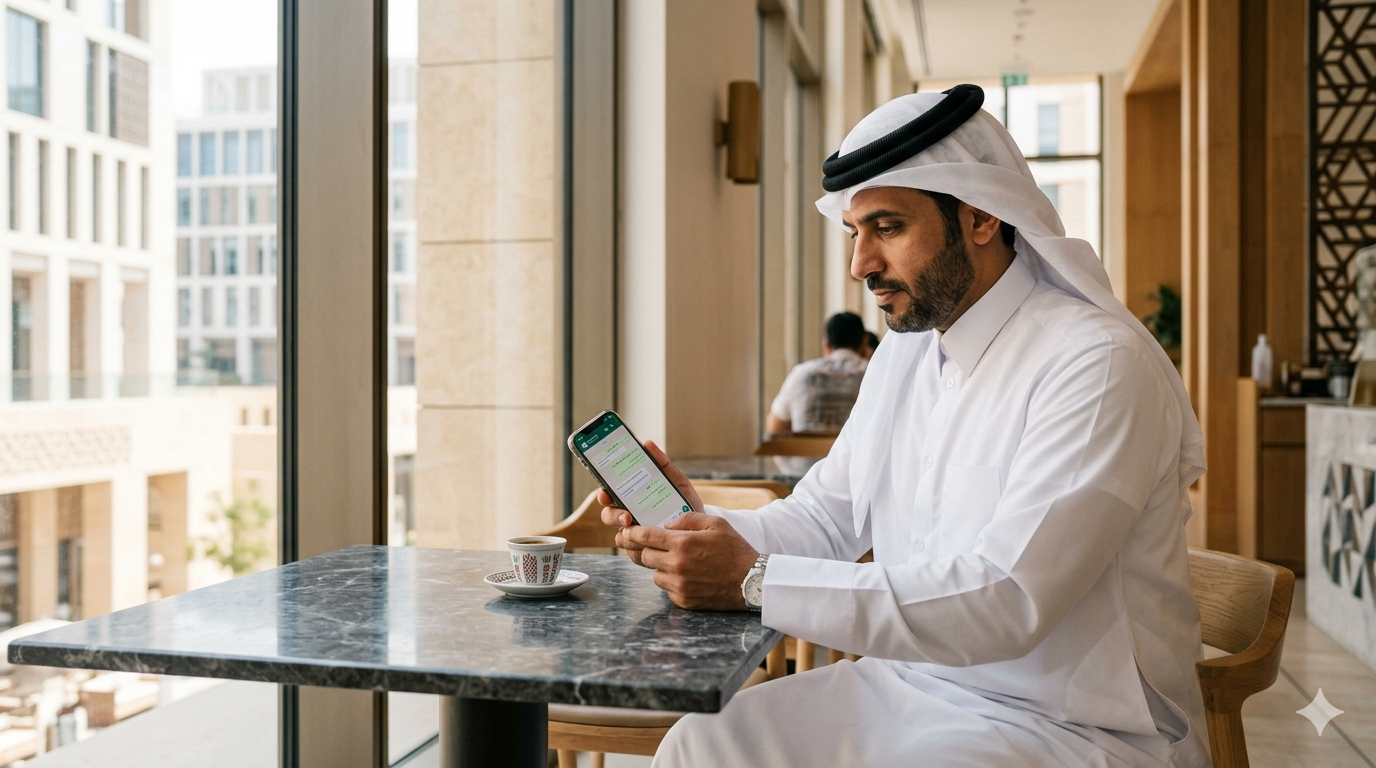
At 9:14 in the morning, in a WhatsApp group called something like Petrochemicals KSA — Operators, a CEO posts a question about a contractor he is considering for a regional services bid. By 9:23, three executives — none of whom have ever sat in a room together — have weighed in. By 10:00, the contractor's reputation has been settled across the senior leadership of an entire industry vertical. By that afternoon, the contractor has either won the deal or lost it.
No email was sent. No meeting was scheduled. No LinkedIn message was opened.
WhatsApp is the operating system of Gulf business. Penetration exceeds 80% of adults in the UAE, Saudi Arabia, and Qatar, and the platform is the primary business communication channel for SMEs across the region. LinkedIn, by contrast, runs in the background. This is the 5-layer system that explains how Gulf business actually gets done — and why most Western cold-outreach playbooks fail here.
A Tuesday Afternoon Inside a Gulf Executive's WhatsApp
Open the phone of a senior executive in Riyadh, Dubai, or Kuwait City on any weekday afternoon. The lock screen is a wall of WhatsApp notifications. Not one or two. Forty. Sixty. Sometimes more.
The groups are layered. There is the company executive group, where the CEO and the C-suite coordinate the day. There is the industry group, where sector peers discuss policy, talent, suppliers, and rumours. There is the alumni group from university or a leadership programme. There is the family group, which the executive checks more often than any other. There is the diwaniya group, which exists in parallel to the physical diwaniya — coordinating attendance, sharing news, debating politics. There is a board group, an investor group, a regulator group. There is, often, a group for a specific deal in flight — formed two weeks ago, dissolved when the deal closes.
The mode of communication is not text. It is voice. 62% of daily WhatsApp users send voice notes, and the rate in MENA is even higher. Text is for foreigners and assistants. Voice notes are the signal that this is a relationship, not a transaction. They get listened to at 1.5× or 2× speed. They convey tone, weight, urgency, hesitation — things that a typed message cannot. A 38-second voice note from the right person can move a deal forward by a week.
The most powerful unit of communication on this phone is none of the above. It is the forwarded message. A colleague sends a screenshot of a contractor's pitch. An uncle forwards a CV. A friend in another company shares a job description. Each forward is a small transfer of social capital from the sender to whomever is being discussed. The forward says: I vouch for this, lightly. It is the modern descendant of an introduction made by hand at the door of a diwaniya — only now it travels at the speed of a tap.
LinkedIn is open in another tab, somewhere. The executive checks it every two or three days, mostly to scan inbound applications and read a few posts. The InMails sit unopened. The connection requests stack up. Some get accepted, weeks later, in a batch.
Anyone doing business in this region has watched this pattern for years. Most have not given it a name.
Why LinkedIn Cold Outreach Has the Worst Response Rates in the Gulf
The numbers are not subtle.
WhatsApp adoption in the UAE, Saudi Arabia, and Egypt exceeds 90 percent. Penetration exceeds 80% of the adult population across the UAE, Saudi Arabia, and Qatar according to the Arab Social Media Report, and the platform is the primary business communication channel for a significant portion of SMEs in the Gulf. Research by Northwestern University in Qatar shows that 75% of nationals in seven MENA countries — Egypt, Jordan, Lebanon, Qatar, Saudi Arabia, Tunisia, and the UAE — already use WhatsApp regularly. Infobip reports WhatsApp grew 36% on its platform in MENA in 2025 and reached 90% UAE penetration.
LinkedIn, in the same region, is used for three things and three things only: the resume, the hire, and the occasional thought-leadership post. LinkedIn is widely described as the most powerful professional tool in GCC job markets — and that "in job markets" qualifier is the entire story. LinkedIn is where you go to be hired. It is not where business is conducted. The platform is a credentials archive, a CV that lives in public. It is rarely a working office.
A cold LinkedIn message to a senior Gulf executive in 2026 typically arrives in an InMail inbox the executive checks weekly at best. It has to compete with thirty other cold messages from sales teams in London, San Francisco, Bangalore, and Tel Aviv, almost all of them following the same template. The message lands in a context where the executive's actual working day — the deals, the introductions, the rumours, the decisions — is happening on a different platform entirely.
The cultural reason for this is older than WhatsApp and older than LinkedIn. In the Gulf, business is relational before it is transactional. The trust that LinkedIn assumes as the input of a connection is, in the Gulf, the output of three or four diwaniya visits, a forwarded voice note, a family-name match, or a coffee at someone's office. GCC business culture and LinkedIn don't translate one-for-one. The introduction that a Western founder treats as a transaction is treated, in the Gulf, as a transfer of social capital from one host to another.
This is not new. It is what business in this region has always been. WhatsApp did not change the culture. It changed the surface. The diwaniya is still the diwaniya. The majlis is still the majlis. The long lunch still closes the deal. But the rapid-fire coordination layer that used to require a personal assistant making phone calls now lives, instantly, in a chat thread.
The Wasta Stack: How Gulf Business Communication Actually Works
When a region's senior decision-makers ignore one platform and live on another, it is worth asking what the working platform actually does for them. The diwaniya, as we have written before in The Lost Art of the Kuwaiti Diwaniya, runs on five quiet principles refined over 250 years. WhatsApp, the modern equivalent of the diwaniya, does something parallel.
The communication system that actually runs Gulf business is layered. Each layer does a specific job. Each one is invisible to the platforms — LinkedIn, email, cold outreach — that most Western playbooks are built on.
We call this system, collectively, The Wasta Stack. Wasta is an Arabic word that, in its working sense, means social capital — the connections and trust that determine who gets heard, who gets introduced, who gets the deal. It is comparable to guanxi in Chinese business culture. It is legitimate social infrastructure, not corruption, and in 2026 it is increasingly channelled through the screen of a smartphone.
Five layers. They run in sequence. Skip one and the relationship does not form.
1. Daily ops — the multi-admin WhatsApp group
The base layer. Every industry, every sector, every city has its WhatsApp group, and the people in it know which group runs which conversation. A logistics group for the Eastern Province. A banking compliance group for the UAE. A petrochemicals operators group for Saudi Arabia. A government-relations group for Kuwait. The groups have admins — usually two or three senior people who founded the group years ago — and membership is by invitation. Joining one is itself a small badge.
This is where deals get announced. Tenders surface here, hours or days before the official RFP is public. Talent moves here, in screenshots of LinkedIn profiles passed quietly between members. Reputations are made or broken in fifteen seconds of voice-note critique. If you are not in the right group for your sector, you are not in the conversation.
2. Relationship — the 1:1 WhatsApp chat
The actual business happens in direct messages. Founders who insist on "let's hop on a call" or "can you send that over email" lose access without quite knowing why. The WhatsApp DM is the working office of Gulf business: it is asynchronous when it needs to be, synchronous when it does not, archived and searchable, and — critically — it carries the same intimacy as a private conversation in a small room.
Email is reserved for documents, contracts, and audit trails. Calls are for closing or escalation. Meetings are for ceremony, alignment, or social validation. But the working conversation — the back-and-forth that moves a deal from hint to handshake — lives in the WhatsApp DM.
3. Trust — the voice note
The voice note is the layer most foreigners do not understand. It is not a convenience. It is a signal. A voice note carries tone, identity, emotion, and time spent. It is harder to fake, easier to remember, and impossible to forward without context. When a Gulf executive switches from text to voice in a conversation, the conversation has graduated. The relationship has changed.
The reverse is also true. A voice note received from someone you know well is more or less an instruction to listen, fully, before responding. To dismiss it with a short text reply is to signal that the relationship is transactional. The voice note is the closest digital approximation of sitting across from someone in a majlis. 62% of daily WhatsApp users globally send voice notes — and in the MENA region the rate is higher still.
4. Introduction — the forwarded message
This is the wasta layer. The moment your name lands in someone's WhatsApp inbox via a person they already trust — a forwarded screenshot of your bio, a voice note saying I worked with this person and they are excellent, a contact card forwarded with a one-line note — you are inside the system. Until that happens, you are outside it.
The forward is the modern version of an introduction made at the door of a diwaniya. The host, who used to vouch for you in person, now vouches for you in a fraction of a second by tapping forward. The receiver opens the forward, sees who sent it, and treats the recommendation accordingly. Cold LinkedIn outreach cannot replicate this. It can only be earned, one introduction at a time, until the people forwarding your name are themselves trusted.
This is also why personal branding in the Gulf has a long history that long predates Instagram bios — what is being forwarded today is the same thing that was being whispered at the door of a diwaniya a century ago. The tool is new. The function is unchanged.
5. Closing — the in-person follow-up
WhatsApp does not close deals. WhatsApp gets you to the meeting. The meeting closes the deal.
The five layers exist to produce the moment where two people sit down — in a diwaniya, at a long lunch, in a corner of a hotel lobby, in an office that an assistant booked specifically because it was on your way — and decide whether to commit. The Wasta Stack is not a substitute for the in-person follow-up. It is the funnel that makes the in-person follow-up worth holding.
A founder who runs the first four layers well and then never travels to Riyadh, Dubai, or Kuwait will not close deals in the region. The room is still the room. The handshake is still the handshake. WhatsApp simply got you near it.
How an Outsider Works the Wasta Stack
The good news for any founder reading this from outside the GCC is that the Wasta Stack is not impenetrable. It is just unfamiliar. The principles are learnable, and the playbook is short.
Step one: get introduced. Cold messages are filtered out by the first three layers of the stack. Spend the first three months of any GCC market entry doing exactly one thing — finding the two or three people in your network who already have credible Gulf connections, and asking them to introduce you. One warm forward is worth a hundred cold InMails. If you do not have anyone in your network who can do this, your first hire or your first advisor in the region should be someone who does.
Step two: move the conversation to WhatsApp the moment the introduction is made. Do not respond to a Gulf WhatsApp introduction by sending an email. Do not propose a calendar invite link. Reply in the platform you were introduced on, briefly and respectfully, with a clear and specific ask. If the conversation lasts more than two exchanges, switch to a voice note as soon as it would feel natural. Keep voice notes under 60 seconds.
Step three: commit to the in-person follow-up. Once a Gulf executive starts replying to you with voice notes, you are on the path to a meeting. Travel. The flight from London to Dubai is six hours, from New York to Riyadh thirteen. Founders who try to close GCC business entirely on Zoom learn, expensively, that the region rewards physical presence in a way no other major market does. Plan three trips before you expect a contract. Six before you expect a relationship.
What not to do: do not paste your pitch deck into a WhatsApp message. Do not send long text messages. Do not add senior executives to WhatsApp groups they did not ask to join — this is treated as a violation. Do not voice-note someone you have never met. Do not pitch in someone else's group. Do not screenshot a private conversation to a public group. The platform is informal, but the cultural rules around it are not.
The Wasta Stack rewards founders who treat it the way a Khaleeji would: relationships first, transactions second, patience as the operating mode. Founders who try to compress the timeline almost always undercompress it and fail. The companies that win in the GCC over the next decade are the ones that already understood, by year three, what most Western entrants only learn by year ten.
The Bigger Picture: A Region That Was Always Built for This
For most of the last fifty years, the Gulf was a market most Western business writing approached with the assumption that the region would, eventually, modernise into something more familiar. The cultural infrastructure — the long lunches, the patient introductions, the family-firm dynamics — was treated as a friction to be eroded by professionalisation, digitisation, and globalisation.
That framing has not aged well. Saudi Arabia had 33.9 million internet users at the start of 2025, with 99% penetration. The UAE has built more startup density per capita than most G7 nations. Vision 2030's missing identity layer has become one of the most-discussed gaps in the region's digital transformation precisely because the underlying infrastructure of trust — the diwaniya, the majlis, the WhatsApp group, the Wasta Stack — was always more sophisticated than Western observers gave it credit for.
In 2026, the Gulf is not modernising into Silicon Valley. The Gulf is doing something more interesting. It is taking the relationship-first business culture that has run the region for centuries and laminating it onto modern technology — WhatsApp, smart contracts, digital identity, AI-powered translation. The result is a market that operates faster than the West on relationship velocity, slower than the West on cold transactions, and substantially more durable on both.
The next decade of GCC business will be defined by founders who understand the Wasta Stack as infrastructure, not as friction. The companies that build for this — including, frankly, those of us building the digital identity layer that powers the forwarded-contact-card moment — are betting on a region whose communication system is already more mature than the platforms most Western incumbents are stuck on. And the GCC will be the first region to drop paper cards entirely, not because of digital novelty, but because the diwaniya never relied on cards in the first place. The principle was always leave a memory. The card was just a temporary technology to do that.
WhatsApp is the current shape of the memory. It will not be the last.
A Closing Scene
It is 9:47pm in Riyadh. The contractor from this morning's WhatsApp group has just received a voice note from a colleague at a different company. The voice note is 22 seconds long. It says, in Arabic, I heard the news. Congratulations. Let's meet for coffee Sunday — I want to discuss something else.
The contractor smiles. He has not opened LinkedIn today. He will not open it tomorrow either.
Somewhere in San Francisco, an enterprise sales rep is composing his fourth LinkedIn InMail of the week to a Gulf executive he has never met. He will not get a reply. He will not understand why.
The Wasta Stack does not announce itself. It just runs.
That is the system POPINID is built to live inside — the moment after the forward, the moment before the meeting, the link someone opens when they are deciding whether to vouch for you.
It begins, as it always has in this part of the world, in a room with no agenda. Or, today, in a chat with no subject line.
Sources cited in this piece:
Infobip Blog (Jan 2026) — WhatsApp statistics 2026: Global usage & market overview
Arab Social Media Report 2024 (via Hyperleap WhatsApp Business Statistics 2026, Feb 2026)
Northwestern University in Qatar — Media Use in the Middle East, multi-country survey
DataReportal — Digital 2025: Saudi Arabia
egrow.com (May 2026) — WhatsApp Commerce Statistics 2026
SEOSouq Dubai — WhatsApp vs LinkedIn for B2B Leads in Dubai
Career Route Gulf (2026) — Networking Tips to Land Jobs in GCC
Dubai Founders Club / EIN Presswire (Dec 2025) — Dubai Founders Club Announces Expansion of Its Business Networking Initiatives