
The Lost Art of the Kuwaiti Diwaniya: What a 250-Year-Old Networking Tradition Teaches Modern Founders
What 250 years of Kuwaiti business culture can teach any founder anywhere

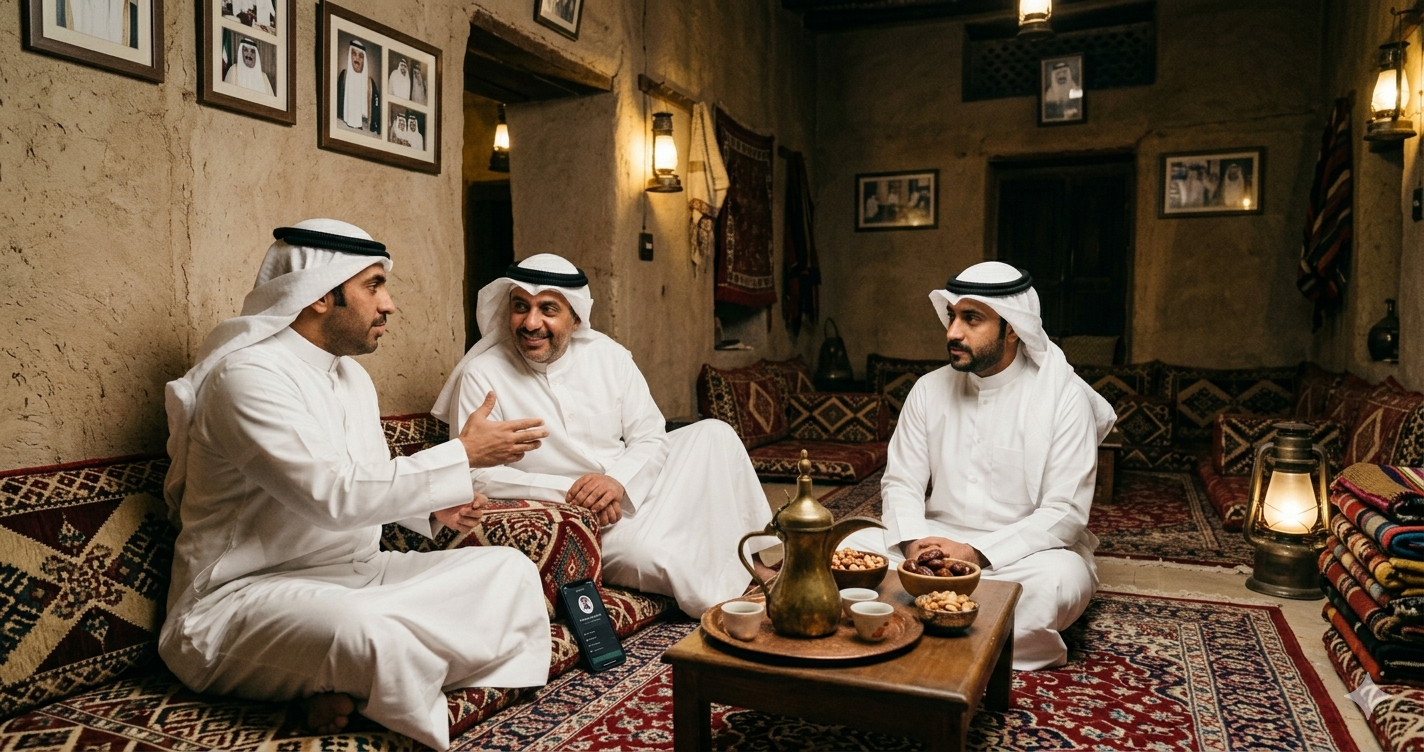
The idea for Kuwait's first formal school was not born in a government office, a foreign mission, or a chamber of commerce. It was born one evening in December 1911, in a private gathering room on a quiet Kuwaiti street, during the commemoration of the Prophet's birthday. By the time the coffee was finished, a school had been agreed, funded, and named. It opened the following year.
The room had a word for itself, then as now. Diwaniya.
A diwaniya is a Kuwaiti gathering — a reception room, often a separate annex to a private home, where men and increasingly women meet weekly to discuss business, politics, and daily life. For more than 250 years it has been Kuwait's most powerful networking system, closing deals that boardrooms never could. This is how diwaniya networking works, and what every founder anywhere can learn from it.
A Tuesday Night in Kuwait That Has Existed Since the 1700s
By 8pm on a Tuesday, in a quiet street in Jabriya or Salwa or Surra, a single door is propped open and a single light is on. The room behind it is not large. Low cushioned seating runs along three walls — the majlis configuration of the Arabian Peninsula. The fourth wall holds a long sideboard with a dallah, the brass coffee pot with a beaked spout, and a tray of small handle-less cups. A bowl of dates. A second bowl of nuts. Sometimes a hookah pipe in a corner, more for atmosphere than for use.
The host — sometimes the patriarch of the family, sometimes his son, sometimes a younger nephew who has inherited the schedule — stands at the door. He greets each guest by name, by family, and by question: how is your father, how is your business, how is your travel. He does not check who else has arrived first. The diwaniya does not start; it accumulates.
By 9pm, twelve people might be in the room. A businessman who runs a logistics company. A parliamentarian. A young returnee with a master's degree from Imperial College, fresh from a year working in London. The CEO of a regional bank. A doctor. A cousin of the host who lives in Bahrain and has come for the week. Two students, deliberately quiet, learning the rhythm. They are not all here for the same reason. Some are here because their father came to this same diwaniya forty years ago. Some are here because there is a deal forming, slowly, in the room. Some are here because there is nowhere else to be on a Tuesday and this is what a Kuwaiti does.
Nobody pitches. Nobody asks for anything in the first thirty minutes. The coffee circulates. The conversation begins on weather and ends, four hours later, on logistics, parliament, family, the Bahraini cousin's olive trees, and — if it is the right kind of evening — a quiet handshake near midnight that will become a contract by Sunday.
This is a diwaniya. There are several thousand of them in Kuwait. They run on every weeknight. They have, in some form, run on every weeknight for more than 250 years.
Anyone who grew up in Kuwait knows the rhythm before they have a word for it.
How Kuwait's Most Influential Boardroom Has No Boardroom
Kuwait was founded as a modern city-state around 1613, and the diwaniya tradition is roughly as old. The Chairman of the Kuwait Heritage Society, Fahad Ghazi Al-Abduljaleel, has placed it at the heart of Kuwait's social fabric since the 17th century. Wikipedia, drawing on the same scholarly history, dates the practice to at least 250 years and credits it with the development of Kuwait's consensual political system.
The word diwaniya is a diminutive of diwan — a word that travels through Persian and Turkish meaning a council, a chamber, or an anthology of poetry. The room is named for the thing it does. It is a place where contributions are collected and assembled. Sometimes those contributions are poems. More often, in modern Kuwait, they are decisions.
The most consequential decision ever made in a Kuwaiti diwaniya may be the founding of Al-Mubarakiya School. In December 1911, during the commemoration of the Prophet Muhammad's birthday, a small group of men gathered at the diwaniya of Yousef Eissa Al-Qinae. By the end of the evening they had decided to build the first formal school in Kuwait. It opened the following year. Kuwait's modern education system traces directly to a single Tuesday-night conversation in a private home.
This pattern repeats throughout Kuwaiti history. In the era when Kuwait's economy depended on the sea, the nokhatha — sea captain — would visit the diwaniya to assemble a pearling crew before a voyage. Businessmen finalized commercial agreements over coffee. Marriages were arranged. Disputes were mediated. The diwaniya served the function that, in other societies, was split across boardrooms, courthouses, churches, and clubs — all in one room, with one pot of coffee.
Modern Kuwait has not abandoned the practice. It has multiplied it. Today there are family diwaniyas tied to specific houses, professional diwaniyas tied to industries (fishermen, doctors, diplomats), sports-club diwaniyas, religious diwaniyas, and a growing category of formal women's diwaniyas. The Cross Cultural Diwaniya, founded in 2013 by Faisal Al-Fuhaid and Leanah Al-Awadhi, has hosted more than 50 forums on topics ranging from women's rights to cryptocurrency to censorship. AmCham Kuwait runs a Women in Business Diwaniya — the most recent one, in February 2026, brought together female founders, fund managers, and the global head of the CFA Institute to discuss financial literacy and capital allocation. Gulf Bank's WOW Diwaniya, founded in 2017, convenes monthly for women employees across departments.
The format is also exported. The Saudi government has run an Entrepreneurship Diwaniya program since 2016, bringing together American and Saudi founders under a Kuwaiti name. In May 2025 the Japanese Ambassador to Kuwait, Mukai Kenichiro, hosted a Japanese-Kuwaiti Business Diwaniya at his residence to advance trade discussions — a major bilateral commercial conversation that took place not in a foreign ministry hall but in a hosted living room, in the format Kuwaitis have used since the 1700s.
When a tradition survives 250 years, multiplies into dozens of variants, and is adopted by foreign embassies for high-stakes commercial discussion, it is no longer a cultural artifact. It is a working technology.
The Diwaniya Principle: Five Rules That Make 250-Year-Old Networking Still Outperform LinkedIn When a system works for two and a half centuries across colonial periods, oil discovery, foreign invasion, occupation, liberation, two Gulf Wars, the rise of the internet, the smartphone, social media, and AI — it is worth asking what the system actually does.
The diwaniya is not a venue. It is a method. Five principles, observed quietly across generations, account for almost all of its effectiveness. We call these, collectively, The Diwaniya Principle.
1. Show up regularly without an agenda
The first rule of the diwaniya is that you appear. Not when you need something. Not when you have something to sell. You appear on Tuesday because the diwaniya is open on Tuesday. The host expects you. The other regulars expect you. Your absence is more conspicuous than your presence.
Over months and years, you become known not for what you said but for the fact that you keep returning. LinkedIn networking inverts this — most people only message when they want something. The diwaniya knows that anything you ask for in your first visit is something you have not earned.
2. Make the host look good
The host's reputation is a currency. Every guest who behaves well, contributes meaningfully, and treats other guests with respect adds to the host's standing. Every guest who pitches aggressively, tries to dominate, or treats the diwaniya as a sales channel subtracts from it.
Quiet contribution — listening, asking good questions, introducing one guest to another — pays dividends that outlast any single visit. The host who likes you will, eventually, mention your name in rooms where you are not present. That mention is worth more than any cold pitch you could send.
3. Listen for two visits before you speak once
A new guest does not arrive and immediately offer opinions. A new guest is introduced, accepts coffee, watches the rhythm of the room, and waits for an invitation. On the second visit, the same. On the third, perhaps a quiet observation. Only when the room has accepted you do your contributions carry weight.
This is a deliberate filtering mechanism. It means the diwaniya is full of people who have learned to wait. Western networking events optimize for talking. The diwaniya optimizes for listening.
4. Carry no card but leave a memory
Nobody hands out business cards in a diwaniya. Nobody asks for your LinkedIn. The exchange is human and unmediated. What gets remembered is not your title but the moment you became useful — the story you told well, the introduction you made between two strangers, the discreet help you offered to someone the host trusts.
Six months later, when a deal forms, you will be the name the host mentions. Not because of a card. Because of a memory.
5. Return before being summoned
The diwaniya does not chase. If you are absent for a month, no one calls to check. The relationship is maintained by the visitor, not the host.
This is the asymmetric reciprocity that makes the system durable: the people who keep returning are, by definition, the people who are committed to the relationship. The people who only show up when they need something are filtered out by their own absence.
How to Run a Diwaniya in San Francisco, Singapore, or Riyadh
The Diwaniya Principle does not require a majlis room, a dallah, or 250 years of family history. It requires a recurring time, a host, and a discipline.
The simplest implementation: a Tuesday-night dinner at the same restaurant, the same table, the same 8pm start, every week, with no agenda and no fixed guest list. The host commits to being there. Regulars rotate. Newcomers arrive through introduction. The dinner ends when it ends. Over a year, the dinner accumulates a roster of fifty to a hundred people who have all sat at that table. The dinner becomes the room that other rooms come from.
We know founders in Riyadh and Dubai running this exact format on Sunday evenings. We know founders in San Francisco running it on Thursday nights at a wine bar in the Mission. We know a Kuwaiti technologist in London who runs a Saturday brunch with the same set of rules — show up regularly, make the host look good, listen before you speak, leave a memory, return before being summoned. In every case, the same effect: deals form sideways. Co-founders meet. Hires happen. Money moves. The work does not get done in the dinner. The work gets done because the dinner exists.
A recommended cadence for anyone starting their own diwaniya:
Weekly is best. Bi-weekly works. Monthly is too sparse — the trust does not compound.
The same time and place every week. The format is the format precisely because it does not require thinking.
The host commits to two years before evaluating. The first six months feel slow. The next eighteen are when the network forms.
One unbreakable rule: no agenda. The moment the dinner has a speaker, a topic, or a sponsored slot, it becomes an event, not a diwaniya. Events end. Diwaniyas accumulate.
The hardest principle to honour in 2026 is the fourth — carrying no card, leaving a memory. The modern equivalent of the card is the digital profile. The thing that lingers after the dinner, the thing that gets opened on the way home, the thing that decides whether you become a contact or a connection, is the page someone visits when they remember your name. The card is gone. The memory is digital. And digital profiles now precede the resume in the Gulf — anyone hiring in Riyadh or Dubai will tell you they check the link before they open the CV.
The question every founder running a modern diwaniya should ask is: when the host mentions my name in a room six months from now, what does the listener see when they search me?
That, in a sentence, is the bet POPINID is built on.
The Bigger Picture: Why GCC Networking DNA Is Becoming a Global Advantage
For most of the last fifty years, the Gulf was a region most Western business writing approached as a buyer market — somewhere to sell oil services to, somewhere to base a regional office, somewhere to negotiate sovereign-wealth allocations. The cultural infrastructure of the region was, at best, an exotic curiosity. Foreign executives flew in for meetings, attended one dinner, and flew out unimpressed by what they took to be inefficiency.
That framing has not aged well. Saudi Arabia's Vision 2030 is moving more than a trillion dollars through new sectors, and Vision 2030's missing identity layer is becoming one of the most-discussed gaps in the region's digital transformation. The UAE has built more startup density per capita than most G7 nations. Kuwait is becoming, slowly, a serious tech market in its own right. The companies winning in this new GCC are the ones that understood, often before their Western competitors, that business in the region was always run on a relational operating system — the diwaniya, the majlis, the long lunch, the patient introduction. The room was never the bottleneck. The room was the point.
Anyone who tried to import a pure LinkedIn-and-cold-outreach playbook into the GCC over the last decade learned quickly that GCC business culture and LinkedIn don't translate one-for-one. The trust that LinkedIn assumes is the output, in Kuwait, of three or four diwaniya visits. The introduction that a Western founder treats as a transaction is treated, in the Gulf, as a transfer of social capital from one host to another.
The diwaniya is now being studied as a deliberate business format. The Saudi Entrepreneurship Diwaniya, run under the patronage of the U.S. State Department and Saudi alumni networks since 2016, has hosted more than 600 participants in design-thinking and venture-building workshops. Embassies use the format for trade. The American Chamber of Commerce uses it for women's financial literacy. Banks use it for talent retention. Twenty years ago, diwaniya was a word most foreign business journalists could not spell. Today it is a recognized organizational practice in international commercial diplomacy.
And personal branding in the Gulf has a long history that long predates Instagram bios — a pearl merchant in 1923 Bahrain operated with a personal reputation more meticulously managed than most modern LinkedIn profiles. The tools are new. The practice is centuries old.
The next 250 years of the diwaniya will look different from the first 250. The room may become digital. The coffee may become a Zoom link. The card has already disappeared, and the GCC will be the first region to drop paper cards entirely — which is itself a return to diwaniya logic, where nobody carried cards in the first place. But the underlying logic — show up, host well, listen long, leave a memory, return before being summoned — does not change. That logic is not Kuwaiti. It is human. Kuwait simply happened to encode it first.
A closing scene
It is nearly midnight in Jabriya. The diwaniya has thinned to four people. The host's son has gone to bed. The dallah is empty. The Bahraini cousin has invited the businessman to visit his olive trees in spring. The young returnee from London has been quietly absorbing notes from the parliamentarian. A handshake has happened that neither party named.
If the diwaniya is about the memory you leave, the way the world saves and shares memory has changed. The card is gone. The connection lives in the link someone opens after they get home.
That is the thread POPINID is pulling on. And it begins, like every good idea in Kuwait, in a room with no agenda.
Sources cited in this piece:
Wikipedia — Dewaniya (en.wikipedia.org/wiki/Dewaniya)
Kuwait Times — Diwaniyas: A Fascinating Cultural Tradition, interview with Fahad Ghazi Al-Abduljaleel, Chairman of Kuwait Heritage Society
LSE Middle East Centre — Reimagining Civic Engagement: Emerging Forms of the Diwaniya in Kuwait (2023)
Springer Nature — Networking and Entrepreneurial Activity in Kuwait, academic chapter
Arab Times — Japan and Kuwait deepen business ties through strategic Diwaniya gathering (May 2025)
AmCham Kuwait / Zawya — Women in Business Diwaniya on Financial Literacy and Investing (February 2026)
Entrepreneur Middle East — Cross Cultural Diwaniya Aims to Foster Open Dialogue on Social Issues
International Exchange Alumni (U.S. State Department) — Saudi Alumni Engage and Network through Entrepreneurship Diwaniya